
Silo Finance — Weekly Risk Report (Week 3)
This report provides a structured weekly risk review of lending markets on Silo Finance. The objective is to identify pools with elevated liquidation, oracle, and liquidity risk under stressed market conditions.
Markets are divided into two segments:
Section A: Core Pools (> $100K collateral deposits)
Section B: Long-Tail Pools (< $100K collateral deposits)
For week 3 we’ll take into account only Section A pools
Risk labeling excludes smart contract exploit risk and focuses on market structure, liquidity depth, oracle design, and liquidation viability.
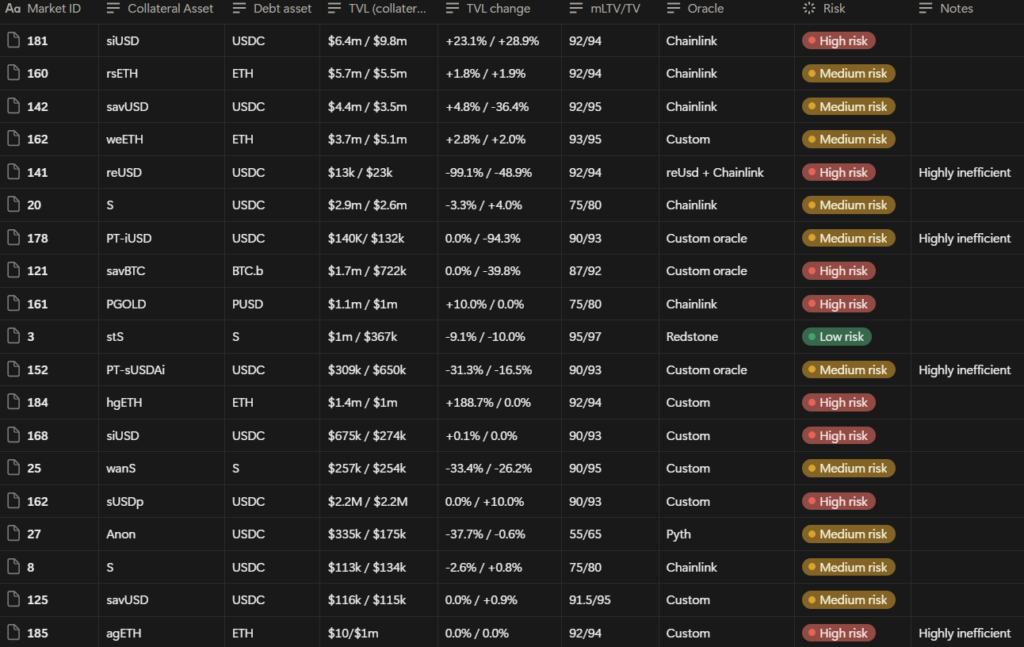
High Risk Pools — Detailed Breakdown
Pool 181 — siUSD / USDC
Key Observations
- Total siUSD DEX liquidity: ~$3.5M
- Total siUSD used as collateral: ~$6.4M
- Documented siUSD depeg history
- Collateral size exceeds reliable exit liquidity
Primary Risk Drivers
- Liquidation cascade risk under stress conditions
- siUSD depeg → liquidation failure → bad debt formation
- Potential death spiral scenario if:
- price deviates,
- liquidation incentives are insufficient,
- gas costs spike simultaneously
Failure Mode
If siUSD depegs and liquidators cannot exit positions profitably due to shallow liquidity and execution costs, liquidations stall and protocol bad debt accumulates.
Suggested Actions
- Increase siUSD DEX liquidity depth
- Reduce siUSD deposit cap
- Temporarily reduce mLTV to ~80% until liquidity and stability metrics improve
Pool 168 — siUSD / USDC
Key Observations
- siUSD collateral exposure remains elevated
- Known historical depeg behavior
Primary Risk Drivers
- Same structural exposure as Pool 181
- Liquidation cascade and death spiral dynamics
- Liquidity vs collateral imbalance risk
Suggested Actions
- Increase siUSD liquidity depth
- Reduce deposit caps
- Lower mLTV to ~80% until stabilization
Pool 141 — reUSD / USDC
Key Observations (Week 1 – week 2)
- reUSD DEX liquidity (Avalanche): ~$1.4M
- reUSD collateral deposited: ~$1.4M
- Oracle-dependent valuation
Primary Risk Drivers
- Oracle freshness dependency
- Liquidity depth insufficient vs collateral
- Stablecoin-style peg fragility risk
Failure Mode (Detected in week 1 – 2)
Oracle lag + liquidity gap → liquidation slippage → bad debt risk.
Status: Capital at risk largely removed
- -99% TVL change → Pool declassified
Pool 121 — savBTC / BTC.b
Key Observations
- savBTC DEX liquidity: < $100K
- savBTC collateral deposited: ~$1.7M
- Custom oracle pricing
Primary Risk Drivers
- Extremely low exit liquidity
- Custom oracle trust assumptions
- Depeg and death spiral risk profile
Failure Mode
Collateral cannot be liquidated at scale → liquidations fail → systemic bad debt.
Suggested Actions
- Freeze market temporarily
- Reopen only after:
- liquidity depth improves materially
- oracle robustness is validated
Pool 161 — PGOLD / PUSD
Key Observations
- Chainlink oracle tracks XAU forex price
- Collateral asset = PGOLD token
- Oracle tracks reference asset, not token market price
Primary Risk Drivers
- Oracle/reference mismatch risk
- Peg trust assumption between PGOLD and XAU
- Token-specific deviation risk not captured by oracle
Failure Mode
If PGOLD deviates from gold price while oracle tracks XAU, protocol may overvalue collateral → bad debt risk.
Suggested Actions
- Validate peg mechanism transparency
- Add token-specific pricing safeguards
- Consider haircut or reduced mLTV
Pool 184 — hgETH / ETH
Key Observations
- Vault-based asset used as collateral
- Oracle relies on NAV valuation
- NAV potentially manipulable depending on vault mechanics
Primary Risk Drivers
- NAV manipulation risk
- Oracle reliability concerns
- Valuation attack surface
Failure Mode
Inflated NAV → overvalued collateral → under-liquidated positions → protocol bad debt.
Suggested Actions
- Freeze market until valuation methodology is fully verified
- Require hardened oracle design
- Add conservative valuation buffers
Pool 162 — sUSDp / USDC
Key Observations
- Custom oracle
- Thin secondary market liquidity
Primary Risk Drivers
- Oracle reliability concerns
- Liquidity depth risk
Suggested Actions
- Require hardened oracle design
- Increase liquidity depth on secondary markets
Highly inefficient Pools
Pool 158 and 172 — PT tokens 19/02/2026 expiry date
Key Observations
- PT-sUSDai (19 Feb 2026) expired
- PT-iUSD (19 Feb) expired
- TVL reduced but sill highly inefficient
Suggested actions
- Update pools ID: 158 and 172 with newest PT collateral
Pool 185 agETH/ ETH
Key Observations
- $1M unused ETH
- $10 worth of collateral deposited